
Pump Selection Data Checklist
A good enquiry connects the liquid, the required duty and the site. Use this checklist to gather the information once, then compare proposals against the same record.
The key decision
Keep flow and head together, identify where measurements were taken, and distinguish confirmed values from estimates. A clearly marked gap is more useful than an invented number.
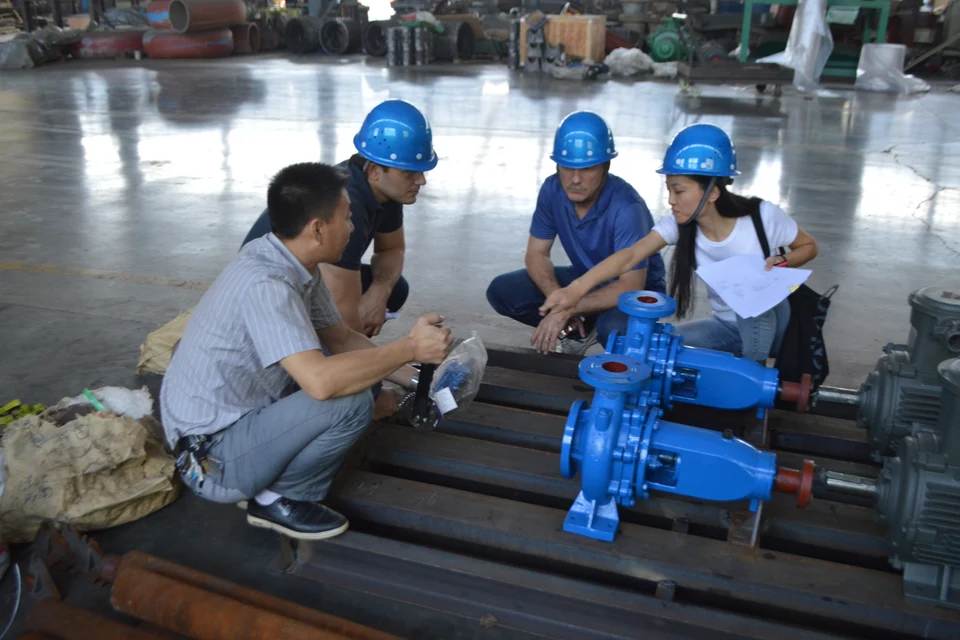
Equipment discussion from the owner-supplied workshop photograph collection.
1. Define the job and the liquid.
Start with one sentence describing what moves, from where, to where and why. State whether the project is a new installation, a replacement or a change in process. For a replacement, include the existing model and explain whether its present duty is satisfactory.
| Record | Include | Avoid |
|---|---|---|
| Liquid | Composition, temperature and relevant density, viscosity or solids data. | A broad label such as “chemical” without composition. |
| Flow and head | Minimum, normal and maximum conditions, paired with units. | Combining maximum flow and maximum head from separate catalogue points. |
| Operating pattern | Continuous, intermittent, batch or seasonal use. | Describing only the peak while omitting normal operation. |
When reporting pressure, identify the tapping or measurement location and whether the value is gauge or absolute. Keep the source of a value beside it: a measurement, a calculation, a process requirement or an estimate.
2. Show the source, the route and the available space.
A simple marked-up site sketch often answers questions that a pump data sheet cannot. Show source and destination levels, the pump position, pipe sizes and the principal fittings. Include level variation and the required delivery pressure where applicable.
- Identify the inlet source: tank, pressurised line, sump or borehole.
- Record available power, connection requirements and any control interface.
- Show access for lifting, dismantling and maintenance.
- Attach the existing arrangement drawing for replacement work.
Do not use the discharge pressure alone as a substitute for the complete head requirement. If the pipe-loss calculation is unavailable, provide the route and dimensions and mark the calculation as an open item.
3. Use a short brief with visible gaps.
Example — enquiry structure, not a selected duty
We need to transfer process water from a storage tank to a treatment line. The normal and peak flow requirements are in the attached duty sheet. We have a pipeline sketch and inlet-level range. Delivery pressure is specified at the process inlet; pipe losses still need review. Please advise the pump direction and remaining data needed for a proposal.
Attach the actual measurements in a table. Avoid burying different operating cases across several email messages; label them consistently in one record.
4. List the equipment and deliverables.
Separate the hydraulic requirement from the commercial supply list. State whether the enquiry is for a bare pump, a pump with drive or a package. Identify controls, instruments, connections and installation accessories that need pricing.
- Model-specific curve and data sheet.
- Arrangement drawing and connection details.
- Required material, inspection and test records.
- Operating manual and any requested spare-parts list.
Ask the proposal to show inclusions, exclusions and unresolved items. A sample document or catalogue picture does not establish the scope of a particular order.
5. Check the record before sending.
Use three simple states: confirmed, estimated and to be provided. Add who can resolve each open item. Check that every duty value has units, each drawing has a revision and the requested equipment matches the project description.
Save the issued brief with the quotation. When the process changes, revise the brief instead of asking a supplier to select against an old duty. Continue with pump selection support when the next step is to discuss the equipment direction.
Frequently asked questions
What if the head is unknown?
Provide source and destination conditions, required delivery pressure and the pipe route. Mark head as unresolved so the calculation basis can be discussed.
Can I use only the old pump nameplate?
Include it, but also describe the current duty, installation and any problem. The nameplate does not describe every site condition.
Which files should accompany the first enquiry?
Start with the duty record, a site or pipeline sketch and relevant equipment references. Add source documents for material or process requirements when available.
Sources and further reading
General references used for this guide. Review the applicable model data and project requirements for your own duty.