


Explore individual products
Open a product page for specifications, construction, installation and original technical documents.

About BBP
Get to know the company, its development and its people.
About BBP
Follow the work from engineering and machining to inspection and testing.
About BBP
Review original records with their named holders and applicable scope.
About BBP
Browse factory photographs, exhibitions and customer visits.
Applications
Cleaning, steel descaling, pressure testing and injection.
Applications
Ore slurry, mineral processing and tailings transfer.
Applications
Sediment removal, submerged slurry pickup and discharge.
Applications
Water supply, circulation and irrigation duties.
Applications
Increase delivery pressure and review changing water demand.
Applications
High-head water transfer and boiler-feed requirements.
Applications
Groundwater lifting, water levels and well installation.
Applications
Wastewater, solids handling and installation access.
Applications
Process-liquid transfer, material compatibility and sealing.
Product series
Product series
Product series
Product series
Product series
Product series
Product series
Product series
Product series
Service & Support
Review the application and technical requirements before an order.
Service & Support
Find support for equipment already in use.
Service & Support
Arrange a discussion, a workshop visit or a service enquiry.
Liquid delivery for cleaning, descaling, testing and injection.
Compare high-pressure plunger pumps for industrial cleaning, steel descaling, pressure testing and injection. Review triplex pump designs and provide the required flow, discharge pressure, liquid properties and operating cycle to shortlist a suitable series.
Explore the pumping head, power end and liquid connections. These equipment views help identify the main components and prepare an installation or replacement enquiry.
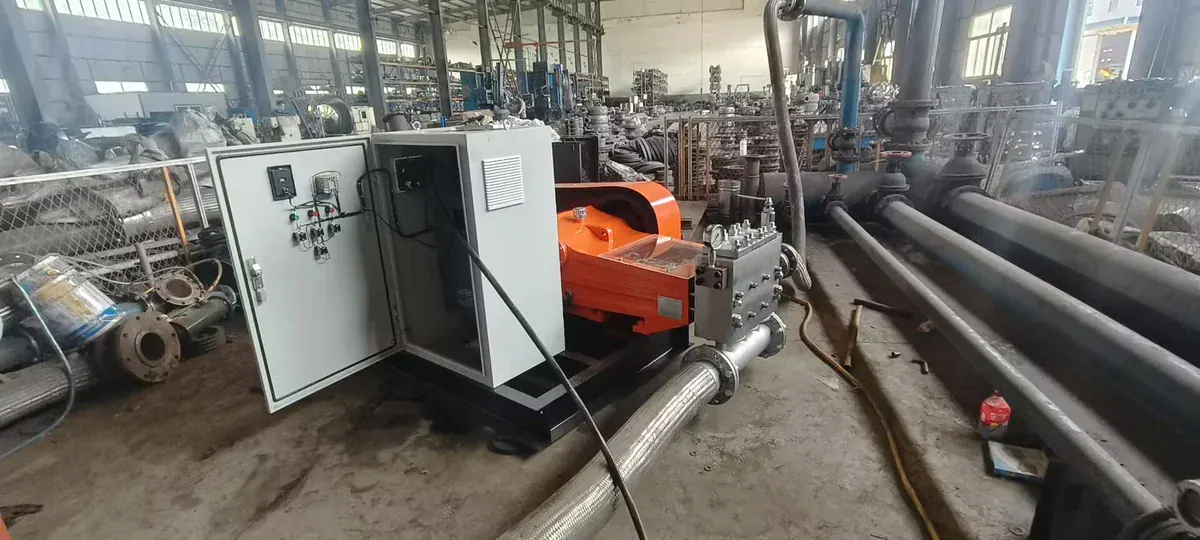
The workshop view shows pumping heads and liquid connections across the assembled equipment. Use an identified pump and its drawing when reviewing your installation.
The pumping head handles the liquid; the power end provides reciprocating motion. Identify both areas when discussing the equipment or replacement components.
Locate the liquid inlet and discharge connections, then compare the required pipework and access with the drawing for your selected pump.
The plungers move back and forth. Liquid enters the pumping head and is discharged into the pressure line as the plungers repeat their stroke.
The pumping head contains the liquid passages and sealing components. The power end supplies the reciprocating motion. These two areas provide useful reference points when identifying the equipment or a part.
An operating duty includes both pressure and flow. The original catalogue gives their relationship under stated operating conditions; a pressure value alone does not describe the amount of liquid delivered.
High-pressure water for removing deposits from surfaces and process equipment. Pressure and flow depend on the cleaning task.
Water delivery to the descaling stage in steel processing, where the pumping duty follows the line’s operating sequence.
Liquid supply for a defined test procedure. Test pressure, flow and holding time describe different parts of the task.
Water delivery into a receiving process. Water quality, inlet supply and receiving pressure define the service conditions.
The original high-pressure pump catalogue contains the parameter tables, dimensions and application pages. Read pressure and flow from the same table condition, together with the stated plunger diameter and speed.
Original PDF · parameter tables, dimensions and application pages.
Share the liquid, operating duty and installation you need.
Open a product page for specifications, construction, installation and original technical documents.
Tell us about your pump, spare parts or project requirements.