
How to Select a Slurry Pump
To select a slurry pump, review particle size, concentration, liquid properties, flow and head together. The installation arrangement then helps identify which pump direction to compare.
The key decision
Record the concentration basis and particle-size information before comparing materials or arrangements. Keep the slurry duty attached to the pipeline and site conditions.
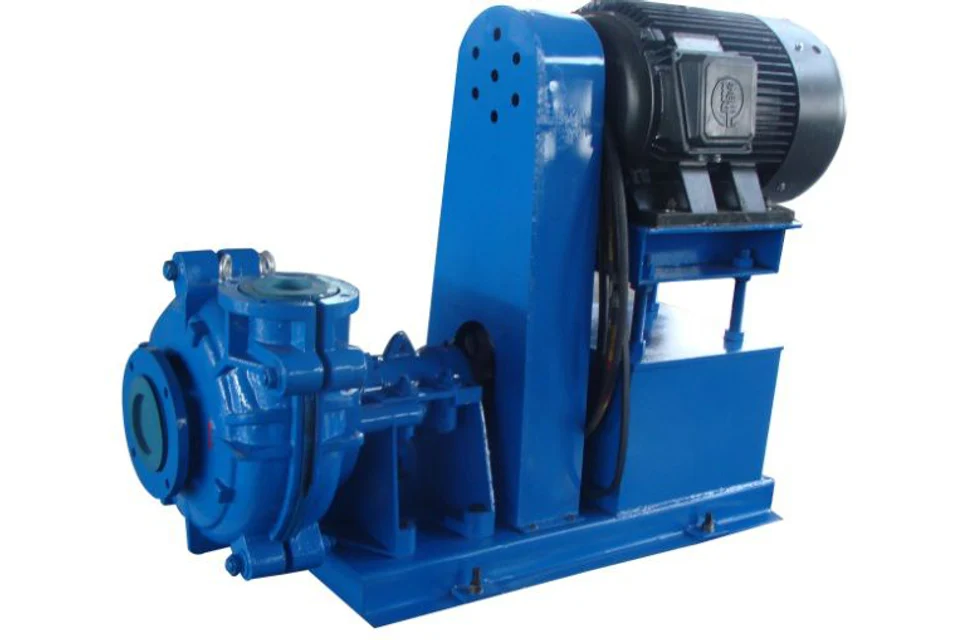
AM catalogue, page 3: a belt-driven horizontal slurry pump set.
1. Describe the solids as well as the liquid.
Identify the process stream and provide the available sample or process data. “Slurry” can describe very different duties; coarse particles, abrasive fines, fibres and chemically aggressive liquid introduce different questions. Describe normal conditions and any changes between batches or campaigns.
| Input | Useful detail |
|---|---|
| Concentration | Value and whether it is measured by mass or by volume. |
| Particles | Size distribution, maximum particle size and relevant shape or hardness information. |
| Density | Slurry density and solids or carrier-liquid density where available. |
| Carrier liquid | Composition, temperature and relevant viscosity or chemistry. |
Preserve the measurement basis from the original report. Do not silently convert a mass percentage into a volume percentage or treat the largest particle size as a full size distribution.
2. Match the arrangement to the installation.
The site determines which equipment arrangements should be compared first. The supplied BBP documents distinguish horizontal, vertical sump and submersible slurry directions.
| Arrangement | Product direction | Installation question |
|---|---|---|
| Dry-installed horizontal | AM / AZ | Where is the pump located relative to the source, and how is the inlet supplied? |
| Vertical sump | AZL / BP / BPR | What sump depth, liquid levels and mounting arrangement must be accommodated? |
| Submersible | QSZ | What working depth, positioning, lifting and discharge arrangement is required? |
These are family directions. They do not make the models interchangeable. Review the chosen arrangement against its own drawings, operating limits and access requirements.
3. Keep performance values with their conditions.
Request the proposed model curve or applicable data table at the stated speed and configuration. Keep flow and head on the same duty line and identify the fluid basis of the published information. Ask how the proposal addresses the actual slurry properties.
The discharge route matters: include elevation, line length, diameter and relevant fittings. If the operating flow varies, describe that range. A catalogue envelope is not a promise that its highest flow and highest head occur together.
4. Review materials and the complete supply.
The AM catalogue shows metal and rubber wear-part arrangements. Treat material selection as a component-level discussion against the medium and particle conditions. The material of the casing alone does not define every wetted component.
- Identify the proposed wet-end materials and component references.
- Discuss sealing and any required supporting services.
- List pump, drive, base, guards and connection items required in the quotation.
- Request the model data, arrangement drawing and spare-parts information needed for the project.
Do not infer a wear-life commitment from a material name or an equipment photograph.
5. Connect the sample information to the site.
Example opening brief
We need a dry-installed pump for a tailings-transfer line. The attached sample report includes particle-size and concentration data with their measurement basis. Our pipeline drawing shows the route and elevation change. Normal and peak duty still need to be agreed. Please advise which slurry series and outstanding data should be reviewed.
Continue with slurry pump families and keep the source report, duty sheet and installation sketch together when requesting a proposal.
Frequently asked questions
Why does the concentration basis matter?
A percentage by mass and a percentage by volume describe different quantities. Keep the basis with the value so the slurry can be interpreted correctly.
Is rubber always preferable for abrasive duty?
Material suitability depends on the complete medium, particle conditions, temperature and component design. Compare the available options against the actual duty.
Can a submersible pump replace a horizontal pump directly?
They have different installation requirements. Compare the inlet or immersion conditions, discharge route, lifting access, power and model data before considering a change.
Sources and further reading
General references used for this guide. Review the applicable model data and project requirements for your own duty.